
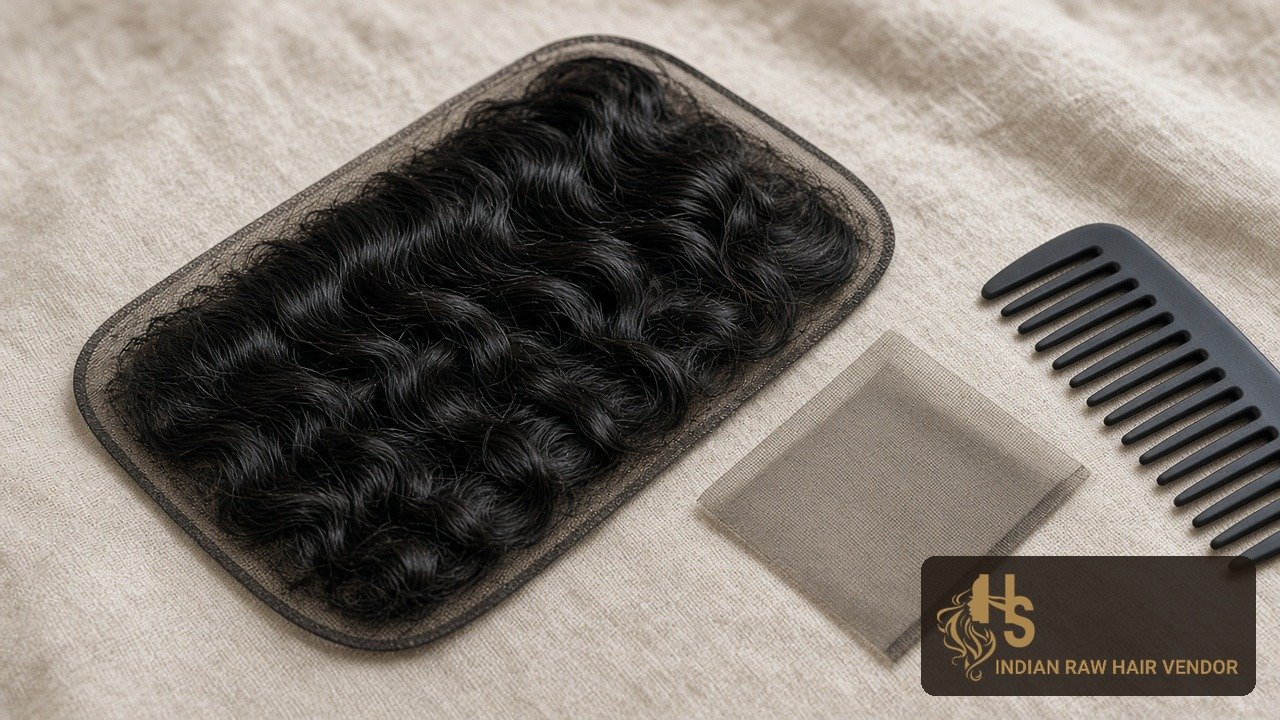
HD lace vs transparent lace is one of the most common questions we get from wig makers, salons and hair brands that are planning their first wholesale order of closures, frontals or lace wigs. Both lace types are thin, both are designed to disappear against the scalp, and both are sold with raw Indian hair knotted into them. Yet they look and behave differently, they suit different customers, and they need different care. This guide explains how each lace is made, how they compare on look, strength, comfort and installation, and how to decide which one to stock for your own clients.
If you are still deciding between unit styles, read our comparison of closure lace wigs, frontal lace wigs and U-part wigs first. This article focuses only on the lace material itself.
What Is the Lace in a Closure, Frontal or Wig?
The lace is the fine mesh base that hair is hand-tied into, one small knot at a time. On a closure it covers a small area at the parting. On a frontal it runs from ear to ear along the hairline. On a full lace or frontal wig it forms the front of the cap. Because the lace sits directly on the skin at the most visible part of the head, the type of lace has a huge effect on how natural the finished install looks.
Lace material is usually described by three things:
- Thickness – thinner lace melts into the skin more easily but is more delicate.
- Colour – clear or transparent lace, light brown, medium brown and dark brown are the common shades.
- Mesh size and softness – a finer, softer mesh lies flatter and is more comfortable, while a firmer mesh holds its shape better.
The hair tied into the lace matters just as much. A beautiful lace with poor hair will still look wrong after the first wash, so always judge the lace and the hair together. Our guide to testing raw human hair covers the hair side.
What Is HD Lace?
HD lace (often marketed as high definition lace, and sometimes compared with Swiss lace) is an ultra-thin, very fine and soft lace. The name has nothing to do with screens; it refers to how invisible the lace looks up close. Good HD lace is so thin that, once it is laid and the edges are blended, it is very hard to see where the lace ends and the skin begins, even in close-up photos.
Advantages of HD lace
- Very close to invisible on most skin tones once installed correctly.
- Soft and light, so it feels comfortable on the forehead and temples.
- Lies very flat, which helps with glueless and lightly glued installs.
- Popular with clients who post close-up photos and videos, and with stylists who want a premium finish.
Disadvantages of HD lace
- Delicate: it can tear if it is pulled hard, brushed roughly or cut carelessly.
- Usually needs gentler handling when knots are bleached and when the unit is removed.
- Shorter lace life if the client wears the unit daily and removes adhesive often.
- Often priced higher than standard lace from most sellers, because of the material and the extra care in ventilating.
What Is Transparent Lace?
Transparent lace is a thin lace that is clear or very light in colour, so it takes on the tone of the skin underneath. It is a little thicker and firmer than HD lace in most cases, which makes it easier to work with and more durable. Many buyers see it as the practical middle ground between standard brown lace and HD lace.
Advantages of transparent lace
- Blends well on light and medium skin tones, and can be tinted for deeper skin tones.
- Stronger than HD lace, so it handles daily wear, washing and re-installs better.
- Easier for newer stylists and DIY customers to cut, lay and remove without tearing.
- Usually a good value choice for volume orders and for everyday units.
Disadvantages of transparent lace
- Slightly more visible than HD lace in close-up photos, especially if not tinted.
- May need tinting or foundation underneath to match deeper skin tones.
- A little firmer, so it can feel less soft than HD lace at the hairline.
HD Lace vs Transparent Lace: Side-by-Side Comparison
The table below summarises the practical differences that matter when you are choosing what to stock or what to recommend to a client.
| Factor | HD lace | Transparent lace |
|---|---|---|
| Thickness | Ultra-thin and very fine | Thin, slightly thicker than HD |
| Invisibility up close | Highest, melts into most skin tones | Very good, may need tinting on deeper skin |
| Softness and comfort | Very soft and light | Soft but a little firmer |
| Durability | Delicate, tears more easily | Stronger, better for daily wear |
| Ease of installation | Needs careful handling | Easier for beginners and DIY |
| Bleaching knots | Needs a gentle, quick approach | More forgiving |
| Typical use | Premium installs, photos, special events | Everyday units, volume orders, re-installs |
| Typical price position | Higher end of a seller’s range | Mid range for most sellers |
Notice that neither lace is simply better. HD lace wins on appearance, transparent lace wins on strength and ease of use. The right choice depends on who is wearing the unit and how they wear it.
How to Choose the Right Lace for Your Customers
Choose HD lace when
- Your clients want the most natural hairline possible and are happy to treat the unit gently.
- You sell premium units, bridal or event installs, or content-creator looks where close-up photos matter.
- Your stylists are experienced with laying, cutting and removing delicate lace.
Choose transparent lace when
- Your clients wear units every day and want them to last through many installs.
- You sell to DIY customers or newer stylists who are still learning to lay lace.
- You want a reliable everyday product for volume orders at a lower price point than HD.
Stock both when
Many wholesale buyers keep both lace types in stock: HD lace for premium closures and frontals, and transparent lace for everyday wigs and repeat customers. Start with a smaller mixed order, test how each performs with your own clients, then scale the type that sells best. Our guide to starting a hair business explains how to plan a first order step by step.
Closures, Frontals and Wigs: Where Lace Type Matters Most
Lace closures
A closure covers only the parting area, so even a small lace edge is visible every time the client changes the part. HD lace is a popular choice for closures because the parting is often the first thing people look at. You can browse our HD lace closures made with raw Indian hair.
Lace frontals
A frontal runs from ear to ear, which means a much longer visible hairline. The lace also has to survive being pulled back, styled and re-laid. Some buyers prefer HD lace for the look, others prefer transparent lace for durability. See our frontals for the options we offer.
Lace wigs
On a wig, the lace is part of a cap that the client puts on and takes off. If the client removes the wig daily, durability becomes more important. For special-occasion wigs, the invisibility of HD lace is often worth the extra care. Browse our wigs, including HD frontal lace wigs and closure lace wigs.
How to Install and Care for Each Lace Type
Installation tips
- Always do a patch test with any adhesive before a full install.
- Cut the lace slowly in small zigzag sections, a few millimetres from the hairline, to avoid tearing HD lace.
- Tint transparent lace with a little foundation, powder or lace tint to match deeper skin tones.
- Bleach knots carefully and for a short time, especially on HD lace, and rinse thoroughly.
- Use a melt band or elastic band to help the lace lie flat while adhesive sets.
Care tips
- Use a gentle adhesive remover and never pull the lace off dry.
- Wash with a mild sulphate-free shampoo and let the lace dry flat.
- Detangle the hair from the ends upward with a wide-tooth comb, holding the hair near the lace.
- Store units on a wig stand or in a breathable bag so the lace keeps its shape.
- Avoid sleeping on an unsecured unit; a silk or satin scarf reduces friction on the lace.
For more on looking after the hair itself, read our care guide for raw Indian hair extensions.
Why the Hair Matters as Much as the Lace
The lace gives the hairline its look, but the hair decides how the unit behaves over months of wear. A unit made with raw Indian hair that has its cuticles intact and aligned will tangle less, hold curls better and keep its shine after washing. Hair that has been heavily processed may look good on day one and then shed or mat after a few washes, no matter how fine the lace is.
When you compare vendors, ask how the hair was collected and processed, which textures are available, and whether the bundles or units are single drawn or double drawn. Be careful with grade labels too; our article on hair grades explained shows why a high number alone proves very little. For a broader checklist, see how to choose raw hair vendors and how to buy raw hair wigs wholesale.
Questions to Ask a Vendor Before Ordering Lace Units
- Which lace types do you offer for closures, frontals and wigs, and what sizes?
- What lace colours are available, and can the lace be customised?
- Is the hair raw and unprocessed, and where is it sourced?
- Are knots bleached or left natural, and are the hairlines pre-plucked?
- What lengths and textures can you supply in the lace style I need?
- What are your shipping and return terms? (Check the written shipping policy and returns policy rather than relying on a chat message.)
Frequently Asked Questions
Is HD lace better than transparent lace?
Not in every situation. HD lace is thinner and more invisible, so it looks better up close. Transparent lace is stronger and easier to install, so it often lasts longer with daily wear. The better choice depends on the client and how the unit will be worn.
Does transparent lace work on dark skin?
Yes, but it usually needs tinting. Because transparent lace is clear or very light, a little lace tint, foundation or powder helps it match deeper skin tones. HD lace often needs less tinting because it is thinner.
Why does HD lace tear easily?
HD lace is made very thin and fine so that it disappears against the skin. That thinness makes it more delicate, so pulling, rough brushing, harsh removal and over-bleaching can cause tears. Gentle handling extends its life.
Can I bleach the knots on HD lace?
Yes, many stylists bleach knots on HD lace, but it should be done carefully, for a short time and on the underside only, followed by a thorough rinse and a neutralising conditioner. Over-bleaching weakens both the lace and the knots.
Which lace should I choose for my first wholesale order?
Many new buyers order a small mix of both: HD lace for premium closures and frontals, and transparent lace for everyday wigs. Testing both with your own clients shows you which one to scale.
Order Raw Indian Hair Lace Units Wholesale
If you are planning an order of closures, frontals or lace wigs made with raw Indian hair, we are happy to help you choose the right lace type, size, length and texture for your customers. Visit our wholesale page, read our FAQ, or chat with us on WhatsApp at +918439889996 to discuss your requirements.

Suraj Gupta
Hair Enthusiast & Founder, Indian Raw Hair Vendor
“I travel across South & North Indian villages to source real, ethically collected raw hair — so you get 100% Authentic Single-Donor Indian Raw Hair with honesty, purity & unmatched quality”
Having 10+ years of excellence in the hair industry & Trusted by 100+ Global stylists to scale their business.

[…] of closure lace wigs, frontal lace wigs and U-part wigs. If you are deciding on lace material, read HD lace vs transparent lace. This article focuses only on […]