
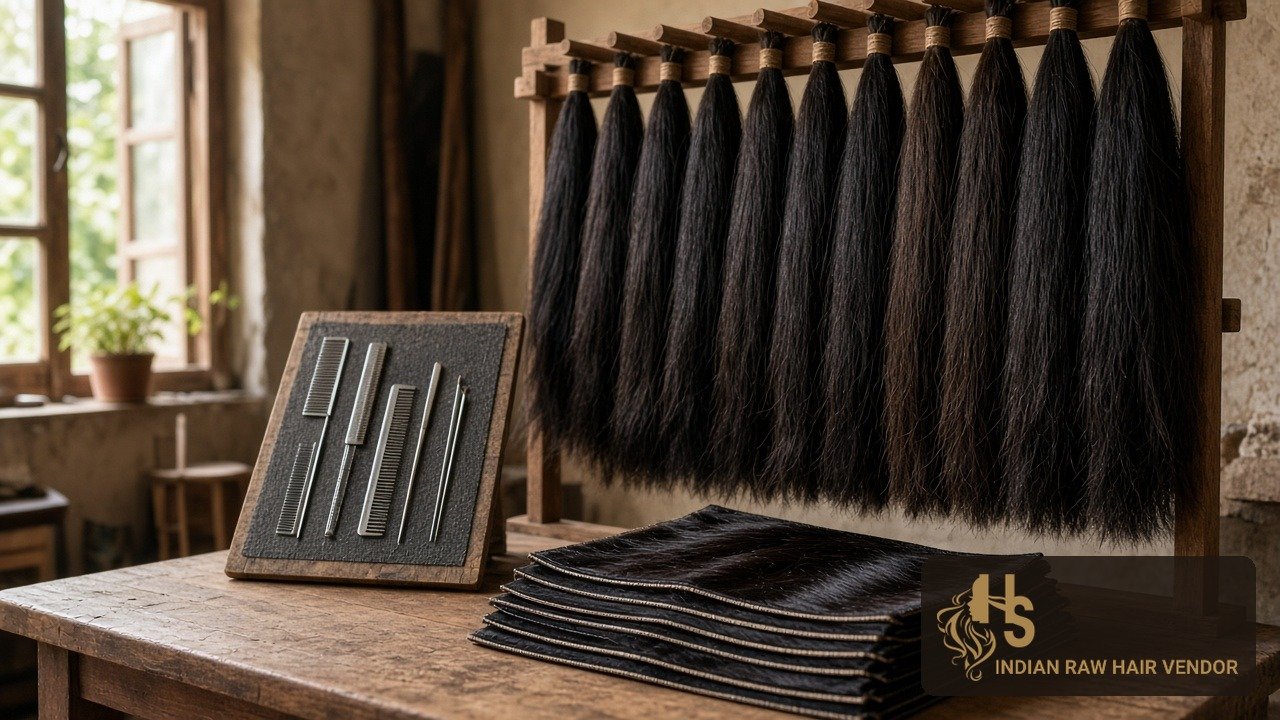
Raw hair manufacturers are the workshops that turn donated human hair into the bundles, bulk hair, closures and frontals you sell or install. If you buy raw Indian hair for a salon, wig line or hair brand, understanding how raw hair manufacturers work helps you judge quality, ask better questions and avoid paying raw-hair prices for processed hair. This guide walks through each stage, from collection to finished bundle, explains what a good raw hair factory controls at every step, and shows how to evaluate a manufacturer before you place a wholesale order.
If you are still comparing the different kinds of sellers in the market, start with our guide to raw hair suppliers, which explains collectors, traders and exporters. This article goes deeper into the manufacturing side.
What Raw Hair Manufacturers Do
A raw hair manufacturer buys or collects hair in its natural state and processes it into products that are ready to sell. The word processing can sound worrying, but for raw hair it should mean mechanical work only: sorting, cleaning, combing, drawing, sewing and packing. A genuine raw line should not be stripped of its cuticle, bleached, permed or coated with silicone to make it look shinier than it is.
This is the key difference between raw hair manufacturers and factories that make processed hair. Processed hair is often acid-washed, steamed into patterns or coloured so that it looks uniform. It can look perfect in the packet but tangle or lose its texture after a few washes. Our article on raw Indian hair vs processed hair explains this in detail.
From Collection to Bundle: The Manufacturing Process
Every raw hair factory has its own way of working, but most follow a similar sequence. Knowing these stages lets you ask a manufacturer exactly where in the chain they work and what they do to the hair.
1. Collection and buying
Manufacturers buy hair from collectors or collect it directly. In India, temple hair is a well-known source, because many people offer their hair during religious ceremonies. You can read more about this source in our South Indian temple hair vendor guide and our article on Indian temple hair extensions. Hair cut in a ponytail keeps the cuticles running in one direction, which is the foundation of good raw hair.
2. Sorting by length, texture and condition
Sorting is slow, careful hand work. Hair is separated by length and by natural texture, such as straight, wavy and curly. Damaged, very short or matted hair is removed. Good sorting is one of the main reasons one batch of raw hair looks consistent and another does not.
3. Cleaning and de-tangling
Sorted hair is washed with mild products to remove dust and oil, then dried and combed out. Careful manufacturers avoid harsh chemicals at this stage, because strong cleaning agents can damage the cuticle that makes raw hair last.
4. Drawing: single drawn and double drawn
Drawing means pulling out shorter strands so the remaining hair is a more even length from root to tip. Single drawn hair keeps some natural shorter strands and has a tapered end. Double drawn hair has more short strands removed, so the ends look fuller, but it takes more hair and more labour to make the same weight. Ask your manufacturer which type you are getting, because it changes both the look and the cost.
5. Wefting or bulk packing
Next, the hair is either sewn onto a track as machine wefts or tied and packed as loose bulk hair for braiding, fusion and custom wigs. On a weft, look for even stitching, a flat track and very little hair falling out when you run your fingers along it.
6. Making closures, frontals and wigs
Many raw hair manufacturers also hand-tie hair onto lace to make closures and frontals, or construct full wigs. This is skilled work, and the knots, lace quality and hairline density all affect how natural the finished piece looks. If you want help choosing between these units, see our guide to closure, frontal and U-part wigs.
7. Quality check, packing and dispatch
Before dispatch, a careful manufacturer checks length, weight, texture and stitching against the order, then packs each bundle so that it does not tangle in transit. For overseas buyers, the manufacturer or exporter also arranges courier shipping and tracking.
Where Quality Is Won or Lost
The table below shows the stages where a raw hair factory can protect quality, and what can go wrong when a step is rushed.
| Stage | What good manufacturers do | What goes wrong when rushed | What you can check |
|---|---|---|---|
| Collection | Keep cuticles aligned in one direction | Mixed-direction hair that tangles | Run fingers up and down a strand |
| Sorting | Separate by length and natural texture | Mixed textures in one bundle | Compare several bundles side by side |
| Cleaning | Use mild washing, no stripping | Dry, brittle hair or coated shine | Wash a sample and let it air dry |
| Drawing | Label single or double drawn honestly | Thin ends sold as full | Measure fullness near the ends |
| Wefting | Even, tight stitching on a flat track | Shedding and bulky tracks | Pull gently along the weft |
| Packing | Pack bundles neatly and label them | Tangling and wrong lengths | Check labels against your order |
Questions to Ask Raw Hair Manufacturers
Before you commit to a stock order, send these questions in writing. A real manufacturer will answer them in detail, because they handle the hair every day.
- Do you sort, draw and weft the hair in your own workshop, or do you buy finished bundles?
- Which region does each line come from, for example South Indian or North Indian?
- Are the textures natural, or created with steam or chemicals?
- Is this line single drawn or double drawn?
- What products do you use to wash the hair?
- Can you make closures and frontals from the same hair as the bundles?
- What is your minimum order, and can I mix lengths and textures?
- Can you send unedited daylight photos or a video of my order before dispatch?
- Which couriers do you use, and how will I get tracking?
For a full checklist covering cuticle, burn and wash tests, see our guide on how to choose raw hair vendors.
Manufacturer, Factory or Reseller: How to Tell
Many sellers online call themselves raw hair manufacturers. Some truly run workshops; others resell stock made elsewhere. Both can be honest businesses, but you should know which one you are dealing with, because it affects how consistent your reorders will be.
Signs you are dealing with a real manufacturer
- They can describe each stage of their process clearly and without vague answers.
- They explain the difference between their raw lines and any processed lines they sell.
- Their photos and videos show their own stock, not images copied from other websites.
- They are open about what is natural texture and what is not.
- They can repeat a specification when you reorder.
Warning signs
- Every possible colour and curl pattern is described as 100 percent raw.
- Prices are far below other raw hair factories for the same length.
- They cannot say where the hair was collected or how it was cleaned.
- Samples feel different from the stock that arrives later.
- They avoid putting the order details in writing.
How to Start Working With a Raw Hair Manufacturer
A steady relationship with a good manufacturer is worth more than one cheap order. These steps keep your risk low while you build trust.
- Decide your core specification. Choose the textures and lengths your clients ask for most.
- Place a small first order. Test the hair before you buy deep stock.
- Test it properly. Wash, blow dry, straighten and wear-test the hair for several weeks.
- Keep a reference sample. Save a piece of approved hair to compare with future deliveries.
- Scale gradually. Increase order sizes as the hair keeps passing your checks.
- Keep records. Save invoices, chats and specifications for every order.
Our raw Indian hair wholesale buying guide covers order planning in more depth, and if you are starting a brand from scratch, read how to start a hair business with raw Indian hair.
South Indian and North Indian Lines
Region affects the textures a manufacturer can offer. South Indian hair is often chosen for natural waves and curls, while North Indian hair suits straighter, sleeker looks. On our About page we describe our South Indian hair as raw virgin hair and our North Indian hair as standard Remy hair, carefully processed to maintain uniformity. Compare the two in our South Indian raw vs North Indian Remy hair guide, browse our South Indian raw hair wefts and North Indian virgin hair wefts, or explore natural patterns in our raw Indian hair textures guide.
Ordering From Indian Raw Hair Vendor
If you are comparing raw hair manufacturers in India, our wholesale enquiry page lets you share your products, texture, length, quantity and delivery country. We confirm current availability, minimum order requirements, pricing, shipping options and estimated dispatch time before you decide, and the page lists a minimum order quantity of 6.
For ready-made starting stock, browse our wholesale deals, including the South Indian temple raw hair wholesale bundle package in 8, 16 and 24 piece sets in straight, natural wavy and raw curly textures. Our wholesale bundle package pages list DHL, FedEx, USPS and TNT as delivery partners, with tracking numbers sent by email and WhatsApp. Before ordering, you can also read our shipping and delivery policy, refund and returns policy and FAQ page.
FAQs
What do raw hair manufacturers do?
They turn collected human hair into finished products. That usually means sorting, cleaning, drawing, wefting or bulk packing, and sometimes making closures, frontals and wigs, without chemical processing on raw lines.
Is a raw hair factory the same as a raw hair manufacturer?
The terms are used in the same way. Both describe the workshop where hair is sorted and made into products. What matters is whether the business does this work itself or resells stock made elsewhere.
What is the difference between single drawn and double drawn hair?
Single drawn hair keeps some shorter strands and has natural, tapered ends. Double drawn hair has more short strands removed, so it looks fuller at the ends but uses more hair to make the same weight.
How can I tell if a manufacturer’s hair is really raw?
Ask how the hair is washed and whether textures are natural, then test a sample. Raw hair should keep its natural pattern after washing, have aligned cuticles and not feel coated or overly silky.
Do raw hair manufacturers sell small orders?
Policies differ between manufacturers. At Indian Raw Hair Vendor, our wholesale page lists a minimum order quantity of 6, and we confirm availability and pricing for your products when you send an enquiry.
Work With a Manufacturer You Can Ask Questions
The best raw hair manufacturers are open about how their hair is collected, sorted and made. Ask detailed questions, test a sample and keep every order in writing. When you are ready, send your product list through our wholesale page or chat with Indian Raw Hair Vendor on WhatsApp to discuss textures, lengths and quantities.

Suraj Gupta
Hair Enthusiast & Founder, Indian Raw Hair Vendor
“I travel across South & North Indian villages to source real, ethically collected raw hair — so you get 100% Authentic Single-Donor Indian Raw Hair with honesty, purity & unmatched quality”
Having 10+ years of excellence in the hair industry & Trusted by 100+ Global stylists to scale their business.

[…] article on how raw Indian hair is made, from collection to bundle walks through each stage in more detail, and South Indian temple hair vendor explains where temple […]