
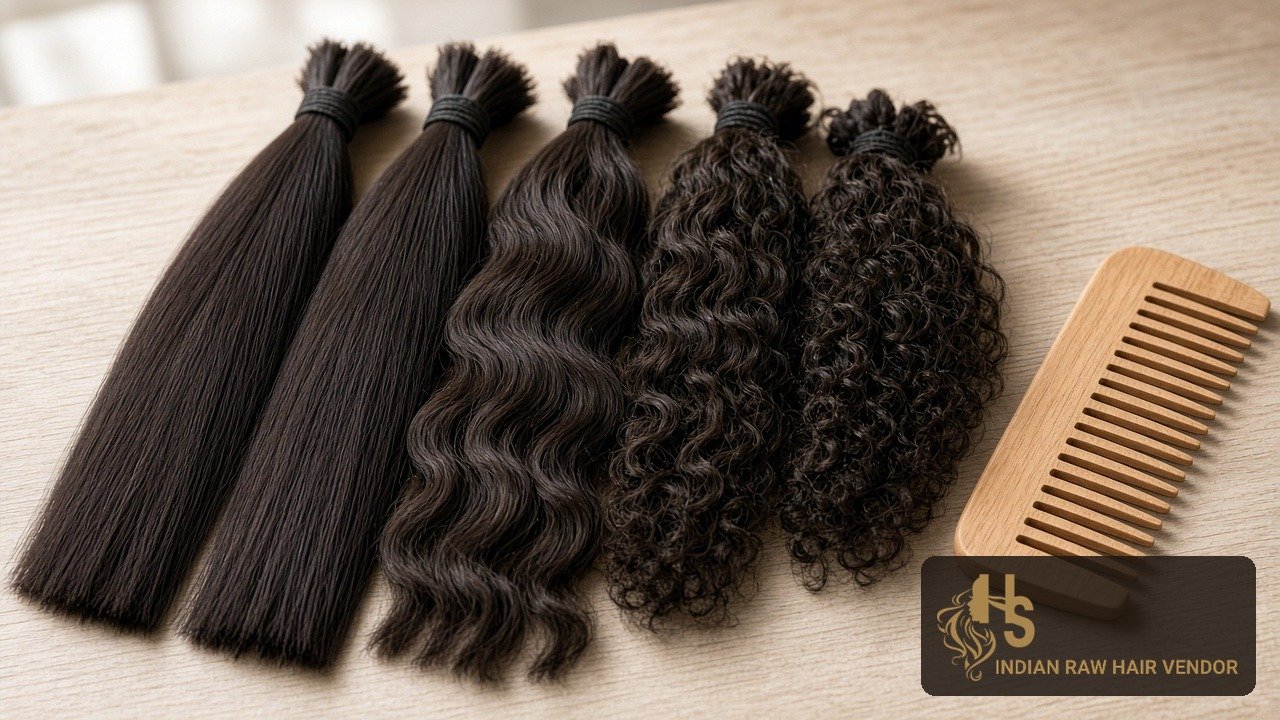
Hair grades explained in one sentence: numbers like 7A, 9A, 10A or 12A are marketing labels that sellers put on bundles, and there is no official body, lab or industry standard that defines them. That surprises many new buyers, because the grade is often the first thing printed on a product listing. In this guide we explain where the grading system came from, what sellers usually mean by each grade, why two 12A bundles from different vendors can be completely different, and which checks actually tell you whether raw Indian hair is worth buying.
If you are comparing suppliers right now, keep our guides on how to choose raw hair vendors and how to test raw human hair open alongside this article. Grades are only one small part of that decision.
Where Do Hair Grades Come From?
The letter-and-number grades became popular with online sellers of bundles and wigs, largely through factory price lists and marketplace listings. Over time, each seller pushed the number a little higher to look better than the competition, so 5A turned into 7A, then 8A, 10A, 12A and beyond. Because there is no regulator behind the scale, nothing stops a seller from labelling a heavily processed bundle as a high grade.
In practice, a grade tells you how the seller wants to position the product in its own catalogue. It does not tell you the hair origin, whether the cuticles are intact, whether the hair was steamed or chemically treated, or how long it will last. Those are the questions that matter for a salon, wig maker or hair brand.
What Sellers Usually Mean by Each Grade
Even without a standard, most sellers use the grades in a roughly similar way. The table below shows the common market meaning, together with what you should actually verify before trusting the label.
| Grade label | What sellers usually claim | What you should verify |
|---|---|---|
| 5A – 6A | Entry-level hair, often mixed or processed, shorter life | Fibre blend, shedding, tangling after one wash |
| 7A – 8A | Mid-range human hair, often described as virgin or remy | Cuticle direction, chemical coating, real length |
| 9A – 10A | Premium hair, often sold as virgin with cuticles | Single donor or mixed, fullness at the ends, colour treatment |
| 11A – 12A and higher | Top-tier label, often marketed as raw | Whether it is truly unprocessed: natural colour variation, no silicone shine, behaviour after washing |
Notice that the right-hand column is the same type of check at every level. A higher grade should mean better hair, but only physical tests and a transparent supplier can confirm it.
Why Two 12A Bundles Can Be Completely Different
Imagine you order a 12A bundle from two different vendors. One may be raw Indian hair from a single donor with cuticles aligned. The other may be mixed hair that was acid-washed, dyed to an even black and coated with silicone to feel silky in the packet. Both carry the same label, and both can look similar in a product photo.
The difference only appears after a few washes. Processed hair usually loses its shine, starts to tangle near the nape and can become dry at the ends. Raw hair keeps its natural texture and movement because the cuticle layer was never stripped. We explain this in more detail in our article on raw Indian hair vs processed hair.
What Really Determines Hair Quality
Instead of relying on a grade, experienced buyers look at a short list of factors that directly affect how the hair performs for the end customer.
1. Origin and Collection
Where and how the hair was collected matters more than any label. Indian temple hair and donor hair are popular because the hair is usually long, strong and naturally dark. Our guide to South Indian raw vs North Indian remy hair explains how regional sources differ.
2. Cuticle Alignment
Remy and raw hair keep all cuticles facing the same direction, from root to tip. This is what keeps the hair smooth and tangle-free for a long time. Mixed-direction hair tangles, no matter what grade is printed on it.
3. Processing Level
Raw hair is not steamed, permed, bleached or coloured. Virgin hair is usually not chemically coloured but may be steamed to set a pattern. Processed hair has been treated to change its colour or texture. Read raw vs virgin vs unprocessed hair for a full breakdown.
4. Fullness and Drawing
How many short hairs were removed from the bundle changes how thick the ends look. Single drawn and double drawn hair can both be raw, but they give different results. See our guide to single drawn vs double drawn hair.
5. Texture and Consistency
Natural raw Indian hair comes in straight, wavy and curly patterns, and small variations between bundles are normal. Perfectly identical bundles in every order can be a sign of processing. Our raw Indian hair textures guide shows what to expect.
Simple Tests Buyers Use Instead of Grades
You do not need a lab to check most of these factors. These quick tests, done on a sample or a first small order, tell you far more than a grade label.
- Wash test: wash the bundle with a gentle shampoo and let it air dry. Raw hair returns to its natural pattern; processed hair often looks dull or frizzy once the coating is gone.
- Cuticle slide test: run your fingers from tip to root along a few strands. Aligned cuticles feel slightly rough going upward and smooth going down.
- Burn test: burn a few strands in a safe place. Human hair turns to ash and smells like burnt hair; synthetic fibre melts into hard beads.
- Colour check: natural raw hair shows slight colour variation and is rarely a uniform jet black.
- Shedding check: gently comb and tug the weft. Some loose hairs are normal at first, but constant shedding points to a weak weft or poor hair.
- Length check: measure the hair yourself and compare it with the stated length.
We describe these tests step by step in our guide to raw human hair vendors.
Questions to Ask a Vendor About Their Grades
When a supplier quotes a grade, ask them to explain it. A trustworthy vendor will answer clearly instead of repeating the number.
- Where is this hair collected, and is it from a single donor or mixed?
- Has the hair been steamed, coloured, acid-washed or coated in any way?
- Are the cuticles aligned in one direction?
- Is it single drawn or double drawn, and how full are the ends?
- Can you share real, unedited photos and videos of the exact bundles?
- What is your return policy if the hair does not match the description?
Good answers to these questions are worth more than any 12A or 15A label. Our raw virgin hair vendor checklist and best raw hair vendors criteria guide help you compare suppliers on the same basis.
How to Use Grades When Selling to Your Own Customers
Many buyers resell under their own brand, and end customers often search for grades. You can still use the terms, but be honest about what they mean. Describe the hair by its real properties – origin, texture, processing level, length and drawing – and treat any grade as a secondary label. This builds trust and reduces complaints and returns.
If you are just starting out, our article on how to start a hair business with raw Indian hair covers sourcing, pricing your range and building repeat customers.
Raw Indian Hair From Indian Raw Hair Vendor
At Indian Raw Hair Vendor we describe our hair by what it is, not by an inflated number. You can browse South Indian raw hair wefts, North Indian virgin hair wefts, bulk hair, closures, frontals and wigs to see the textures and lengths available. Before ordering, please read our FAQ, shipping and delivery policy and refund and returns policy.
Common Myths About Hair Grades
- Myth: a higher number means longer life. Lifespan depends on cuticle condition, processing and care, not on the label. See our raw Indian hair care guide.
- Myth: every 10A or 12A bundle is virgin hair. Many high-grade listings are steamed, coloured or coated hair.
- Myth: grades describe the origin. A grade says nothing about whether hair is Indian, temple, donor or mixed.
- Myth: you can see the grade in a photo. Filters, lighting and silicone shine make processed hair look premium online. Only samples and wash tests reveal the truth.
Keeping these myths in mind protects your budget and your reputation, especially when you place larger repeat orders.
Frequently Asked Questions
Is there an official standard for hair grades like 10A or 12A?
No. Hair grades are marketing labels created by sellers. No official organisation defines or tests them, so the same grade can mean different things at different vendors.
Is 12A hair always better than 10A hair?
Not necessarily. A 10A bundle from an honest supplier can be better than a 12A bundle from another seller. Compare origin, cuticle alignment and processing level instead of the number.
What grade is raw Indian hair?
Raw Indian hair is defined by being unprocessed and cuticle-aligned, not by a grade. Many sellers label it with their highest grade, but the label alone does not prove that the hair is raw.
How can I check hair quality without trusting the grade?
Order a small quantity first and run a wash test, cuticle slide test, burn test, colour check and shedding check. These show how the hair will behave for your customers.
Should I mention grades when I sell hair under my own brand?
You can, because customers search for them, but explain the real properties of the hair as well. Honest descriptions lead to fewer returns and more repeat buyers.
Talk to Us About Wholesale Raw Indian Hair
If you want hair that is described honestly, without inflated grade labels, we are happy to answer your questions about origin, texture, drawing and lengths. Contact us through our wholesale page or chat with us on WhatsApp at +918439889996.

Suraj Gupta
Hair Enthusiast & Founder, Indian Raw Hair Vendor
“I travel across South & North Indian villages to source real, ethically collected raw hair — so you get 100% Authentic Single-Donor Indian Raw Hair with honesty, purity & unmatched quality”
Having 10+ years of excellence in the hair industry & Trusted by 100+ Global stylists to scale their business.
