
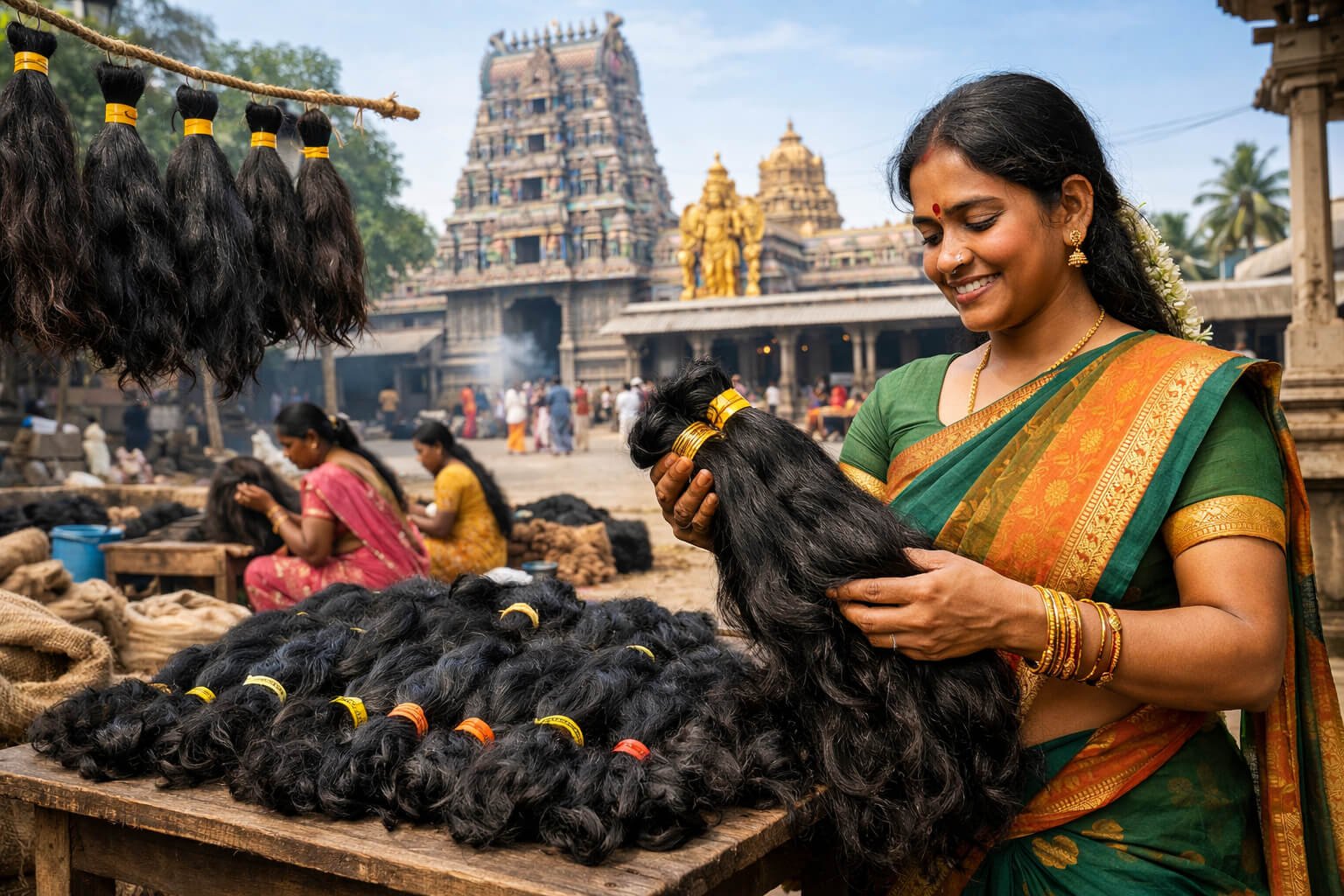
South Indian Temple Hair Vendor: Complete Guide to Premium Raw Hair Sourcing in 2026
Looking for authentic South Indian temple hair vendors who supply premium raw Indian hair? You’ve come to the right place. South Indian temple hair represents the gold standard in the global human hair industry, prized for its unmatched strength, natural shine, and virgin quality.
In this comprehensive guide, we’ll reveal everything about South Indian temple hair vendors—from how they source raw temple hair to why this hair commands premium prices worldwide. Whether you’re a salon owner, hair extension business, or distributor, understanding temple hair vendors is crucial for your success.
Quick Navigation:
- What makes South Indian temple hair special?
- How temple hair auctions work
- Why vendors pay premium prices
- Global demand statistics
- How to verify authentic temple hair
- Top sourcing locations in South India
What Is South Indian Temple Hair? (And Why Everyone Wants It)
South Indian temple hair is human hair donated by Hindu devotees during sacred tonsuring ceremonies at major temples across South India. Unlike commercial hair, temple hair is:
- 100% virgin and unprocessed – No chemicals, dyes, or treatments ever applied
- Naturally thick and strong – Indian genetics produce dense, resilient hair strands
- Cuticle-intact – All cuticles aligned in one direction for tangle-free performance
- Ethically sourced – Voluntary donations during religious rituals, not purchased from individuals
- Genetically superior – South Indian hair grows longer and thicker than most other origins
The Sacred Origin: Top Temple Hair Sources
The most prestigious temple hair vendors source from these world-famous temples:
| Temple Name | Location | Annual Hair Collection | Hair Characteristics |
| Tirupati Balaji | Andhra Pradesh | 500+ tons/year | Thick, wavy, dark brown/black |
| Palani Murugan | Tamil Nadu | 200+ tons/year | Natural wave, medium density |
| Guruvayur Temple | Kerala | 150+ tons/year | Silky, naturally straight |
| Sabarimala Temple | Kerala | 100+ tons/year | Coarse, curly texture |
Source: Temple administration reports 2025-2026
Did you know? Tirupati Temple alone collects over 500 tons of hair annually, making it the world’s largest single source of human hair. This temple’s hair auctions generate ₹200-300 crore ($25-35 million USD) yearly, funding massive charitable programs.
What Does a South Indian Temple Hair Vendor Actually Do?
A temple hair vendor isn’t just a buyer—they’re a critical link in the global hair supply chain. Here’s their complete role:
1. Temple Auction Participation
Only licensed and registered vendors can participate in official temple hair auctions. The registration process requires:
- Government-issued trade license
- Export authorization (for international vendors)
- Bank guarantee or security deposit
- Previous auction track record (for established vendors)
- Temple committee approval
2. Quality Assessment and Grading
Expert temple hair vendors inspect and grade hair by:
- Length categories: 6-10 inches, 10-16 inches, 16-24 inches, 24+ inches
- Texture types: Straight (10%), Wavy (60%), Curly (25%), Deep wave (5%)
- Color classification: Natural black (#1B), Dark brown (#2), Medium brown (#4)
- Grey hair percentage: Premium lots contain less than 2% grey
- Damage assessment: Checking for split ends, dryness, or previous chemical exposure
3. Processing and Preparation
After purchasing at auction, vendors process the hair through:
- Cleaning: Industrial washing to remove dirt, oil, and impurities (NO chemicals)
- Detangling: Careful combing to preserve cuticle alignment
- Sorting: Separating by length within 1-inch accuracy
- Cuticle alignment: Hand-arranging so all cuticles face the same direction
- Bundling: Creating standard 100g bundles for wholesale
- Quality control: Final inspection before packaging
4. International Export and Distribution
Leading South Indian temple hair vendors manage:
- Export documentation and customs clearance
- Hygiene certificates and quality attestations
- International shipping logistics (DHL, FedEx, Air Freight)
- B2B relationships with hair manufacturers worldwide
- Wholesale pricing and bulk order fulfillment
At Indian Raw Hair Vendor, we handle all these steps in-house at our Saharanpur facility, ensuring complete quality control from temple to your door.
Inside the Temple Hair Auction: How the System Really Works
Temple hair auctions are sophisticated, transparent events that follow strict protocols:
The Auction Process (Step-by-Step)
Step 1: Hair Collection (Year-round)
- Devotees donate hair during tonsuring ceremonies
- Temple staff collect, clean, and store hair in secure warehouses
- Hair is sorted into preliminary categories
- Auction lots are prepared (typically 5-20 tons per lot)
Step 2: Auction Announcement (30-60 days before)
- Public notices in newspapers and temple websites
- Registered vendors receive direct invitations
- Auction catalog published with lot details
- Pre-auction viewing dates announced
Step 3: Pre-Auction Inspection (7 days before)
- Vendors physically inspect hair lots
- Quality assessment and sample testing allowed
- Estimated value calculations performed
- Bidding strategies prepared
Step 4: Auction Day (Competitive Bidding)
- Sealed bid or open auction format
- Minimum reserve prices set by temple
- Highest bidder wins each lot
- Immediate payment required (bank transfer or demand draft)
- Legal ownership transfers instantly
Step 5: Post-Auction Collection
- Winner collects hair within 15-30 days
- Temple provides authenticity certificates
- Transportation arranged by vendor
- Temple records maintained for transparency
What Do Vendors Pay? (2026 Price Ranges)
| Hair Length | Quality Grade | Price per KG (₹) | Price per KG ($) |
| 6-10 inches | Standard | ₹8,000-12,000 | $95-145 |
| 10-16 inches | Premium | ₹15,000-22,000 | $180-265 |
| 16-24 inches | Premium | ₹25,000-35,000 | $300-420 |
| 24+ inches | Super Premium | ₹40,000-60,000 | $480-720 |
Note: Prices fluctuate based on auction competition, hair quality, and global demand
Why South Indian Temple Hair Commands Premium Prices Worldwide
International buyers pay 3-5X more for South Indian temple hair compared to other sources. Here’s why:
1. Genetic Superiority
South Indian genetics produce hair with unique characteristics:
- Higher keratin density: 20-30% more protein than European or East Asian hair
- Thicker cortex: Results in stronger, more durable strands
- Natural melanin richness: Deep, lustrous black color that ages beautifully
- Uniform diameter: Consistent thickness from root to tip
2. Zero Chemical Exposure
Temple donors typically:
- Never dye or color their hair (religious practice)
- Avoid relaxers, perms, or chemical straightening
- Use minimal styling products (traditional oils only)
- Maintain natural hair care routines
This makes temple hair the purest virgin hair available anywhere in the world.
3. Perfect Cuticle Alignment
Unlike collected or purchased hair (often tangled), temple hair is:
- Cut in single direction during tonsuring
- Immediately bundled to preserve root-to-tip orientation
- Stored in aligned state from donation to processing
Result: Extensions that never tangle, even after 2-3 years of use. Learn more about raw Indian hair textures and their properties.
4. Proven Longevity
Independent testing shows South Indian temple hair lasts:
- 2-3 years with proper care (vs. 6-12 months for processed hair)
- 50-80 wash cycles before noticeable degradation
- Multiple color treatments without structural damage
- Heat styling up to 180°C repeatedly without breakage
5. Versatile Styling Options
Because it’s 100% virgin hair, temple hair can be:
- Dyed from black to any lighter shade
- Bleached to blonde (with professional care)
- Permed or relaxed
- Heat-styled daily
- Kept in natural state for authentic look
This flexibility makes it ideal for custom wig manufacturing and high-end salons.
Global Market Analysis: Where Temple Hair Goes
South Indian temple hair vendors export to over 50 countries. Here’s the breakdown:
Top Import Markets (2026 Data)
| Country/Region | Market Share | Primary Use | Annual Value |
| United States | 35% | Wigs, weaves, extensions | $280M |
| China | 25% | Wig manufacturing | $200M |
| European Union | 15% | Luxury hair systems | $120M |
| Nigeria/Africa | 12% | Weaves, braids | $95M |
| Middle East | 8% | Custom wigs | $65M |
| Other markets | 5% | Various | $40M |
Total market value: $800 million USD annually (2026 estimate)
Why USA and China Lead
United States:
- Huge African-American market for weaves/wigs
- High disposable income allows premium pricing
- Celebrity and influencer culture drives demand
- Medical wig market (cancer patients)
China:
- World’s largest wig manufacturing hub
- Re-exports processed hair globally
- Domestic market of 200M+ women
- Advanced processing capabilities
Want to tap into these markets? Our guide on starting a hair business with raw Indian hair wholesale covers market entry strategies.
How to Identify Authentic Temple Hair Vendors (Avoid Scams)
The temple hair market has fraud. Here’s how to verify authentic vendors:
Red Flags (Walk Away If You See These)
- ❌ Prices significantly below market rates (30%+ discount)
- ❌ No physical factory address or phone number
- ❌ Unwilling to provide samples before bulk order
- ❌ Can’t show temple auction certificates
- ❌ Only accepts Western Union or crypto payments
- ❌ No business license or export documentation
- ❌ Pressure tactics (“special price expires today”)
- ❌ Claims to have “exclusive temple contract” (temples don’t do this)
Green Flags (Signs of Legitimate Vendor)
- ✅ Factory visits welcome (with appointment)
- ✅ Provides temple auction receipts with lot numbers
- ✅ Active social media with customer testimonials
- ✅ Accepts PayPal, bank transfer, credit cards
- ✅ Offers hair testing lab reports
- ✅ Has been in business 5+ years
- ✅ Transparent about processing methods
- ✅ Provides return/refund policy in writing
- ✅ Responsive customer service (24-48 hour replies)
The 5-Point Verification Test
Before placing a bulk order, perform these tests on samples:
1. Burn Test (Verify 100% Human Hair)
- Take 5-10 strands
- Light with match or lighter
- Human hair: Burns slowly, smells like burning flesh, turns to ash
- Synthetic: Melts, smells like burning plastic, forms hard ball
2. Bleach Test (Check for Previous Processing)
- Apply 20-volume bleach to small section
- Virgin hair: Lightens evenly without melting
- Processed hair: Becomes gummy, breaks, or doesn’t lighten uniformly
3. Tangle Test (Cuticle Alignment Check)
- Wet the hair thoroughly
- Shake vigorously for 30 seconds
- True temple hair: Minimal tangling, easily combs through
- Low-quality hair: Matts severely, difficult to detangle
4. Shed Test (Weft Quality)
- Hold weft and run fingers through 10 times
- Count fallen strands
- Acceptable: 3-5 strands maximum
- Poor quality: 10+ strands indicates weak wefting
5. Grey Hair Percentage
- Examine 100g bundle closely
- Premium temple hair: <2% grey strands
- Standard quality: 2-5% grey acceptable
- Low quality: >10% grey (often indicates old or mixed hair)
Need detailed testing guidance? Read our complete guide on raw vs. processed Indian hair quality indicators.
South Indian vs. North Indian Temple Hair: Key Differences
Both regions produce excellent hair, but characteristics differ:
| Characteristic | South Indian | North Indian |
| Natural texture | Wavy to curly (60-70%) | Straight to slightly wavy (70-80%) |
| Hair thickness | Medium to thick | Fine to medium |
| Color range | Dark brown to jet black | Medium brown to dark brown |
| Average length donated | 10-20 inches | 12-24 inches |
| Volume/density | Higher (more hair per donor) | Moderate |
| Best for | Curly/wavy extensions, wigs | Straight extensions, closures |
| Price premium | 15-25% higher | Standard market price |
Learn the complete comparison in our detailed article: South Indian Raw vs North Indian Remy Hair.
The Business of Temple Hair: Revenue and Impact
How Much Do Temples Earn?
Tirupati Temple (2025-26 Financial Year):
- Hair auction revenue: ₹285 crore ($34 million)
- Number of auctions: 6 per year
- Average price per kg: ₹22,000 ($265)
- Total hair sold: 520 tons
Where Does This Money Go?
- 40% – Free meals (Annadanam) for pilgrims (20,000+ meals daily)
- 25% – Temple maintenance and staff salaries
- 15% – Free hospitals and medical camps
- 10% – Educational institutions and scholarships
- 10% – Community development projects
Temple hair revenue directly funds massive charitable operations benefiting millions of people annually.
Environmental and Sustainability Considerations
Temple hair is one of the most sustainable beauty products on Earth:
- 100% biodegradable – Unlike synthetic wigs that take 500+ years to decompose
- Zero waste production – Even short unusable strands are sold for industrial use (oil spill cleanup, amino acid extraction)
- No animal involvement – Completely cruelty-free
- Renewable resource – Continuous supply through voluntary donations
- Low carbon footprint – Minimal processing compared to synthetic alternatives
For eco-conscious brands, temple hair is the ethical choice.
How to Work with a South Indian Temple Hair Vendor
For Salons and Stylists:
- Start with sample orders (3-5 bundles) to test quality
- Communicate your specific needs: texture preference, length, color
- Establish payment terms: Many vendors offer net-30 for established clients
- Ask about wholesale pricing: Volume discounts typically start at 10 bundles
- Request care instructions: Educate your clients for better retention
For Distributors and Manufacturers:
- Factory visit recommended before first bulk order (100+ kg)
- Discuss processing capabilities: Steam processing, texture customization
- Negotiate exclusivity agreements: For specific regions or product lines
- Set up quality control protocols: Pre-shipment inspection, sample approval
- Establish logistics partnership: Reliable shipping is crucial
Typical Order Process:
- Inquiry: Contact vendor with your requirements
- Quote: Receive pricing based on specifications
- Sample: Order paid samples to test quality (1-3 bundles)
- Evaluation: Test samples thoroughly (1-2 weeks)
- Bulk order: Place main order with 30-50% deposit
- Production: 15-30 days for custom orders
- Quality check: Pre-shipment inspection
- Shipment: 5-7 days express, 15-20 days standard
- Payment: Balance due on delivery or before (based on agreement)
Caring for Temple Hair: Maintenance Guide
Proper care ensures temple hair lasts 2-3+ years. Here’s the essential guide:
Washing Protocol
- Frequency: Every 2-3 weeks (or after 8-10 wears for wigs)
- Water temperature: Lukewarm, never hot
- Shampoo: Sulfate-free only (sulfates strip natural oils)
- Technique: Downward motion only, never circular scrubbing
- Conditioning: Mid-shaft to ends, avoid roots
- Deep conditioning: Monthly treatment with natural oils
Styling Best Practices
- Heat setting: Maximum 180°C (350°F)
- Heat protectant: Always use before blow drying or flat ironing
- Detangling: Wide-tooth comb, start from ends
- Brushing: Paddle brush with natural bristles preferred
- Overnight protection: Silk bonnet or satin pillowcase
For complete maintenance instructions, visit our raw Indian hair care guide.
Frequently Asked Questions (FAQs)
1. Is temple hair really better than other types of Indian hair?
Yes, for several reasons. Temple hair is donated during religious ceremonies, meaning donors have never used harsh chemicals, dyes, or treatments. The hair is collected, sorted, and stored properly from the moment of donation, preserving cuticle alignment. Additionally, because it comes from temple auctions, there’s complete transparency in sourcing—you can trace it back to specific temples and auction dates.
2. How can I verify if my vendor truly sources from temples?
Legitimate temple hair vendors can provide: (1) Temple auction receipts with lot numbers and dates, (2) Temple board certificates of authenticity, (3) Dated photographs from auction events, (4) Business registration showing temple trade authorization. If a vendor can’t provide these, they’re likely sourcing from regular hair collectors, not temples.
3. What’s the minimum order quantity for wholesale?
Most South Indian temple hair vendors require a minimum of 3-5 bundles (300-500g) for wholesale pricing. For significant discounts (15-25% off), you typically need to order 20+ bundles (2kg+). Custom processing orders may require higher minimums (50-100 bundles).
4. Can temple hair be dyed or bleached?
Absolutely. Because it’s virgin hair with intact cuticles, temple hair accepts color beautifully. You can dye it to any darker shade easily. Bleaching to blonde is possible but should be done professionally in stages to avoid damage. The hair can withstand multiple color treatments that would destroy processed hair.
5. Why is South Indian temple hair more expensive than North Indian?
South Indian hair naturally grows thicker and with more wave/curl pattern, which is in higher global demand. The genetics produce denser hair strands with higher keratin content. Additionally, South Indian temples conduct fewer but larger auctions, creating more competitive bidding. The combination of superior quality and higher auction prices results in 15-25% premium over North Indian hair.
6. How long does shipping take for international orders?
From India to most countries: Express shipping (DHL/FedEx) takes 5-7 business days. Standard air freight takes 12-20 days. Sea freight (for very large orders of 100+ kg) takes 4-6 weeks but costs significantly less. Customs clearance adds 2-4 days depending on the destination country.
7. Do temples ever run out of hair to sell?
Major temples like Tirupati never run out—they collect 500+ tons annually with continuous donations year-round. However, smaller regional temples may have seasonal variations, conducting auctions only 2-3 times per year when they’ve accumulated sufficient quantity (usually 10-50 tons minimum per auction).
8. Is there a difference in quality between different temple sources?
Yes, subtle differences exist. Tirupati hair tends to be thicker and wavier (Andhra Pradesh genetics). Kerala temples produce silkier, slightly finer hair. Tamil Nadu temples offer medium density with natural wave. However, all South Indian temple hair is premium quality—the differences are preferences, not quality grades.
9. Can I visit the factory before placing a large order?
Reputable vendors welcome factory visits. Most are located in Saharanpur (North India processing hub) or Chennai/Bangalore (South India). Schedule 7-14 days in advance. During visits, you can see processing operations, inspect inventory, meet quality control teams, and sample products. This builds confidence for $10,000+ orders.
10. What payment methods do temple hair vendors accept?
Professional vendors accept: Bank wire transfer (SWIFT/IBAN), PayPal (Business accounts), Western Union/MoneyGram (for smaller orders), Credit cards (through payment gateways), and Letter of Credit (for very large orders $50,000+). Avoid vendors who only accept cryptocurrency or insist on Western Union—these are red flags.
Conclusion: Why South Indian Temple Hair Vendors Matter
South Indian temple hair vendors are more than businesses—they’re custodians of a centuries-old tradition that benefits everyone involved:
- Devotees fulfill religious vows through hair donation
- Temples generate massive revenue for charitable programs
- Vendors build sustainable businesses on ethical sourcing
- Manufacturers access the world’s finest raw hair material
- End users enjoy premium, long-lasting hair extensions
The temple hair trade exemplifies how commerce and spirituality can coexist beautifully, creating value across the entire supply chain while maintaining ethical standards.
Whether you’re a salon owner seeking premium hair for discerning clients, a distributor building inventory, or a manufacturer requiring bulk raw materials, partnering with an authentic South Indian temple hair vendor is your foundation for success in the competitive hair extension industry.
Ready to Source Premium South Indian Temple Hair?
Indian Raw Hair Vendor has supplied authentic South Indian temple hair to businesses worldwide since 2015. We participate in major temple auctions, operate our own processing facility in Saharanpur, and maintain strict quality standards throughout production.
What we offer:
- ✅ Direct temple auction sourcing with certificates
- ✅ Factory-direct pricing (no middlemen)
- ✅ Free samples on request (freight collect)
- ✅ Custom processing for bulk orders
- ✅ Express international shipping (5-7 days)
- ✅ 30-day satisfaction guarantee
- ✅ 24/7 WhatsApp support: +91-8439889996
Learn More About Raw Indian Hair
Want to become an expert in Indian temple hair? Explore our comprehensive resource library:
- 📚 Indian Temple Hair Extensions: Everything You Need to Know in 2026 – Master guide covering types, sourcing, quality verification, and purchase considerations
- 🔬 Raw Indian Hair vs Processed Hair: Which is Better for Extensions? – Scientific comparison analyzing quality, longevity, cost-effectiveness, and styling versatility
- 💼 How to Start a Hair Business with Raw Indian Hair Wholesale – Complete entrepreneurial roadmap from product selection to marketing and scaling strategies
- 🧴 Complete Raw Indian Hair Care and Maintenance Guide – Professional care protocols for washing, conditioning, heat styling, and storage to maximize lifespan
- 🌊 South Indian Raw vs North Indian Remy Hair: Complete Comparison – Regional analysis explaining genetic differences, texture variations, and best use cases
- 🎨 Raw Indian Hair Textures Explained – Visual guide to natural straight, wavy, curly, and deep wave patterns with styling recommendations
Have questions? Our hair experts are available 24/7 via WhatsApp at +91-8439889996. We respond to all inquiries within 2-4 hours.
Disclaimer: Prices and statistics mentioned are based on 2026 market data and temple auction records. Actual prices vary based on quality grade, order quantity, and current market conditions. Temple auction participation requires proper business licensing and compliance with Indian export regulations.

Suraj Gupta
Hair Enthusiast & Founder, Indian Raw Hair Vendor
“I travel across South & North Indian villages to source real, ethically collected raw hair — so you get 100% Authentic Single-Donor Indian Raw Hair with honesty, purity & unmatched quality”
Having 10+ years of excellence in the hair industry & Trusted by 100+ Global stylists to scale their business.
